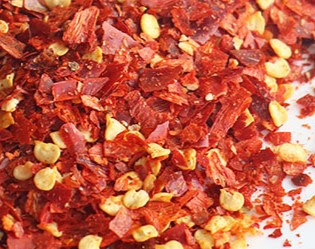
Chili flakes, also known as crushed chili peppers, are a spice or condiment made from crushing dried chili peppers. They are typically red and have a spicy, peppery flavor. Red chili flakes add a lot of spice to the dish and bring a beautiful heat to the recipe.
Dried red chili flakes are filled with antioxidants that help fight oxidative stress in the body and promote overall good health. Chile flakes also are a great appetite suppressant, so they are good for whom are on a diet or are trying to eat less food.
Traditional chili flakes come from chili or cayenne peppers, but these relatively small, red chilis are the most commonly used in preparing this seasoning. Chili flakes is made by roasting red chilies until crisp and pulsing it. Chili flakes is not usually grinded instead crushed / pulsed in mixer to get those perfect flakes.
Chilies have little aroma but they vary in taste from mild to fiery-hot. Generally, large flat round fleshy varieties are milder than small, thin-skinned pointed types. Capsaicin, which is present in the seeds, veins and skin, gives chilies their kick.
Chili flakes is used many dishes as garnish or even as a condiment /spice. It is used in pasta, soup, pizza, bread, buns etc.
Chili flakes
LEARN ABOUT FOOD INGREDIENT AND THE FUNCTION OF FOOD INGREDIENT. INGREDIENT IS A SUBSTANCE THAT FORMS PART OF A MIXTURE. IN COOKING OR FOOD PROCESSING, RECIPES SPECIFY WHICH INGREDIENTS ARE USED TO PREPARE A SPECIFIC DISH. MANY COMMERCIAL PRODUCTS CONTAIN A SECRET INGREDIENT PURPOSELY TO MAKE THEM BETTER THAN OTHERS.
Showing posts with label chili. Show all posts
Wednesday, June 21, 2023
Monday, May 04, 2009
Capsicum
Capsicum
Capsicum, cayenne pepper and chilies are all names given to members of the various Capsicum species and varieties used extensively in foods.
The names are legion and often very local (particularly in Mexico) so that considerable confusion arises over what is meant in a formulation by the term “cayenne pepper”; to some users it is particularly hot and to their relatively mild, depending upon the regional source of the capsicum used.
The genus Capsicum is widely distributed and exists in innumerable sizes, shapes, colors and levels of pungency; but the fruits can be roughly divided into main groups:
a. The large fleshy fruits of Capsicum annuum, L.
b. The small fruited Capsicum minimum, Roxb, or C. frutescens, L.
The least pungent varieties are the large fleshy red and green peppers which are not unlike a tomato and used more as a flavorful vegetable than as a spice.
Paprika is also at this end of the scale although some varieties may indeed be slightly pungent.
The most pungent are the very small fruits of C. frutescens which are also widely known as African Chilies.
In between these two extremes there is a whole spectrum of varieties. It would be something of an oversimplification to say that the larger the fruit the more colorful and less pungent it is.
The larger and sweeter (less pungent) types of capsicum are generally well known and widely used in food processing and domestically.
They are often called “chili pepper” and this title, particularly in the United States, must not be confused with “chili powder” which is really a specially blended product which forms a complete piquant seasoning.
Capsicum
Capsicum, cayenne pepper and chilies are all names given to members of the various Capsicum species and varieties used extensively in foods.
The names are legion and often very local (particularly in Mexico) so that considerable confusion arises over what is meant in a formulation by the term “cayenne pepper”; to some users it is particularly hot and to their relatively mild, depending upon the regional source of the capsicum used.
The genus Capsicum is widely distributed and exists in innumerable sizes, shapes, colors and levels of pungency; but the fruits can be roughly divided into main groups:
a. The large fleshy fruits of Capsicum annuum, L.
b. The small fruited Capsicum minimum, Roxb, or C. frutescens, L.
The least pungent varieties are the large fleshy red and green peppers which are not unlike a tomato and used more as a flavorful vegetable than as a spice.
Paprika is also at this end of the scale although some varieties may indeed be slightly pungent.
The most pungent are the very small fruits of C. frutescens which are also widely known as African Chilies.In between these two extremes there is a whole spectrum of varieties. It would be something of an oversimplification to say that the larger the fruit the more colorful and less pungent it is.
The larger and sweeter (less pungent) types of capsicum are generally well known and widely used in food processing and domestically.
They are often called “chili pepper” and this title, particularly in the United States, must not be confused with “chili powder” which is really a specially blended product which forms a complete piquant seasoning.
Capsicum
Subscribe to:
Posts (Atom)
Popular Posts
-
Acetylated Monoglyceride An emulsifier manufactured by the interesterification of edible fats with triacetin in the presence of catalysts ...
-
What is Food Additive? The broadest definition of a food additive is any substance that becomes part of a food product, either directly or ...
-
Substance that make a batter rise are called leavening agents. Leavening agents play a crucial role in the development of muffins. In making...
-
Carrageenan in Gummy Candies Gummy candies are included in a large category of confectionary products such as jellies, pastilles, and win...
-
Fenugreek flavor Fenugreek is a small European annual herb of the natural order Leguminoseae and now widely cultivated in southern Europe, N...
